Because some things just need to be shared.
Something happened this week. I was teaching a class on enriched breads, and had spent weeks testing and testing to get everything perfect. There was pain de mie, beautiful braids of challah, petit brioche a tete, and lots of parker house rolls. When I envisioned the class, I pictured mountains of breads, which I personally found very appealing. But I was worried that people wouldn’t think it was exciting enough. I needed some intrigue. A wild card. Something to get people in the door. I needed cinnamon rolls.

I’ll be honest, two weeks ago I was pretty ambivalent about cinnamon rolls. Sure, they were nice. I mean, who’s going to complain about swirly squishy bread covered in cinnamon and frosting? But I had never had my mind blown by a cinnamon roll. Cinnabons are pretty good, I guess, but I can literally taste the chemicals on my tongue after attempting to eat one of those. Weirdly enough, when I was thinking back to formative cinnamon bun years, they seemed to revolve around those canned ones at the grocery store that you ice yourself and aren’t even swirly. A dressed up version of those, that was the cinnamon bun of my dreams. So with that weird little canned bun in mind, I set about developing a recipe.

It only took about four tries. It helped that I already had the dough worked out from the sticky pecan buns that I taught last summer (aaaah, another blog post that I started and never finished…sigh). It was all about getting the flavors right. And I’m pretty sure I nailed it. I’m also pretty sure that in those four days of trying, followed by four days of teaching and baking the rolls, I transitioned from an ambivalent cinnamon roll passer-by to a full fledged devotee. Around day 6 I started dreaming about them. Then I started seeing them everywhere: coasters, camera lenses, even my cat all rolled up while sleeping started looking like a cinnamon bun that I really, REALLY wanted to nibble on (as if I actually eat them that daintily). It was all I talked about on facebook, prompting some recipe requests, which made me think: “hey, I know what I haven’t done in a while: a blog post!” So here I am, sharing these rolls, because dammit, they are worth breaking my four-month blog pause to share. Enjoy.

Cinnamon Rolls:
Yield: 12 rolls
Dough:
12 ounces bread flour
1 1/2 tablespoons sugar
1 1/2 teaspoons instant yeast
1/2 teaspoon kosher salt
3 ounces whole milk, lukewarm
3 large eggs, room temperature
1 egg yolk, room temperature
6 ounces unsalted butter, soft
Cinnamon Filling:
5 ounces brown sugar
5 teaspoons cinnamon
1/4 teaspoon kosher salt
3 ounces unsalted butter, soft
Cream Cheese Glaze:
2 1/2 ounces cream cheese, soft
2 ounces unsalted butter, soft
3/4 cup powdered sugar
1/4 teaspoon kosher salt
1/2 vanilla bean or 1/2 teaspoon vanilla extract
1 tablespoon milk
Make the dough:
– Stir together the flour, sugar, yeast and salt in a stand mixer bowl (or large mixing bowl). Combine the milk and eggs in a separate small bowl. Pour the egg mixture in the dry mixture and stir until smooth. Let this mixture rest for about 5 minutes so that the gluten can begin to develop.
– One piece at a time, knead in the butter, waiting until each addition of butter assimilates before adding more. This will take a few minutes. Continue mixing for about 6 more minutes, or until the dough is very well mixed. You will have to scrape down the bowl from time to time as the dough will cling to it. The dough will be very smooth.
– Place the dough in a large bowl. Cover the pan with plastic wrap. If making that day, place in a warm spot to rise. Once risen, place in the fridge to chill before rolling, As cold dough is much easier to work with. If making in advance, put the dough into the refrigerator and chill overnight, or for at least 4 hours.
Assemble the buns:
– Mix together the cinnamon, sugar and salt and set aside.
– On a floured work surface, roll out the brioche into rectangle about 12 by 16 inches and 1/4-inch thick. It should be fairly easy to roll. Position the rectangle so a long side is facing you. Spread the soft butter evenly over the entire surface of the dough, then sprinkle on the cinnamon sugar mixture. Starting from the side closest to you, roll up the rectangle like a jelly roll. Try to roll tightly, so you have a nice round spiral. Trim off about 1 inch from each end of the roll to make them even. If at any point the dough becomes warm or sticky, place it in the fridge to chill for 10 minutes.
– Use a bench scraper or knife to cut the roll into 12 equal pieces, each about 1 1/2-inches wide. At this point, the unbaked buns can be tightly wrapped in plastic wrap and frozen for up to 1 week. When ready to bake, thaw them, still wrapped, in the refrigerator overnight or at room temperature for 2 to 3 hours, then proceed as directed.
– Butter a 9”x13” baking pan. Arrange the buns, evenly spaced, in the pan. Cover with plastic wrap and put in a warm spot to proof until the dough is puffy, pillowy, and soft and the buns are touching-almost tripled in size, about 2 hours.
– Position a rack in the center of the oven, and heat to 375 degrees. Bake until golden brown, about 20 to 25 minutes. While the cinnamon rolls are baking, prepare the glaze.
Glaze the buns:
– Whisk together all of the glaze ingredients until smooth.
– When the cinnamon rolls are finished baking, you can decide whether to glaze them warm or after they’ve cooled. One at a time, invert the buns onto a wire cooling rack. Spread the glaze onto them, you will have more than enough.
How to picnic like it’s your wedding day.
So this year was a big one for me. The Pantry turned one, I finally went to Canada, and after dating for 6 years, me and John got married.
I know, I know: A) this post is over due (sorry, yet again!) and B) It’s frickin’ Thanksgiving, all you want to hear about is another variation on sweet potatoes and brussels sprouts. But think of this as a holiday oasis post, a place you can come to forget about the will-it-EVER-stop rain (if you live in Seattle) and instead remember summertime, picnic blankets, sundresses and adorable foods on crackers.
It was a gorgeous August weekend in the Cascade Mountains, 80 degrees and sunny, with the crisp waters of Lake Wenatchee a five minute drive away. It was a weekend filled with friends, singing, dancing, and of course, whole lot of food.

I was never going to be a traditional bride — white ball gowns and pretty pictures of me gazing into the sunset are definitely not my thing. And I’ve got plenty of political ideas about marriage and taxes and civil rights that have kept me from taking the idea of a wedding seriously for most of my life. It really took a mental shift, reframing the idea of a wedding ceremony to get me on board. It doesn’t have to be about poofy dresses and until sickness and death parting us, or about weird beef dishes from the 60s and the electric slide. It can be about friends. And our rather tiny families. And celebration. And where there’s celebrating, there’s food. And board games. And lawn games. And a lemonade stand. And midnight re-enactments of frogger with hacky sacks. And karaoke with lots of dancing.

Since so many of our guests were coming from far away, we wanted the wedding to to take over a weekend, giving us as much quality time as possible — and, of course, providing us with plenty of opportunities for meals.
I like to dream big, and I’ve never met a culinary challenge that was too intimidating. So as you can imagine, the days leading up to the wedding were slightly insane. I am forever indebted to all my friends who spent many hours cooking, pickling, packaging, and labeling all the food that would become welcome snacks for our guests, breakfast baskets that got delivered to everyone’s cabins, and finally make it into the main event: a wedding picnic in the mountains.

We spent months scavenging for picnic baskets, vases and picture frames at the thrift stores, and then painted them all bright aqua blue. We filled them with all of our favorite things, and sewed napkins, streamers and pillows out of vintage fabric I found at my great-grandmother’s house in Alabama. Actually full credit for napkin sewing goes to Mariah, my close friend and inspiration for all things domestic, because she didn’t even blink when I dropped a box of vintage fabric on her porch before hopping on a plane back to Seattle. It was not a white wedding. It was bright. It was patterned. And nothing matched. It was perfect.

We had olives marinated with rosemary, orange and chile flakes, and herb roasted nuts.

A tuna salad with tarragon, fennel and celery leaves, concocted by my business partner Olaiya Land, that pretty much stole the show.

Some Olympic Provisions salami and our favorite cheeses: Cowgirl Creamery’s Mt. Tam and Jasper Hill’s clothbound cheddar.

Pickled cucumbers with fennel fronds and some red pepper jelly that my family is still asking about.

Smokey baba ganoush, which I think is responsible for keeping me fed the entire weekend, and a white bean and kale salad dressed with a preserved lemon vinaigrette, recipe courtesy of our friends at Picnic.

And since I’m a pastry chef and John has an unrivaled sweet tooth, there was plenty of dessert: lemon pound cake and my most favorite banana bread ever, and rhubarb ginger jam made by Rebecca of Deluxe Foods. Three days before the ceremony I let go of the plan to make homemade nutella. It was the right decision.

I still think about that weekend. Having everyone with us, being able to feed them. Swimming in the lake, playing kickball in the sun, eating dinner under the stars – I can’t even imagine a different kind of wedding. Thank you to all of my friends, for being there and for being so awesome. And a special thank you to Gabe and Ashley Rodriguez, for taking such beautiful pictures that will make me remember that weekend in visual style.

Marinated Olives w/ Rosemary, Orange & Chile
8 cups caselvetrano olives
4 cups olive oil
4 oranges
4 six-inch sprigs rosemary
1 tsp chile flakes
8 garlic cloves
– Using a vegetable peeler, remove zest from orange in long, wide strips. Smash garlic cloves with the edge of a chef’s knife.
– Place the olive oil in a small saucepan along with the orange zest, rosemary, pepper flakes and garlic. Warm over medium heat until fragrant but not boiling or simmering. Turn heat to medium-low and add olives. Stir occasionally for about 5 minutes. Do not cook olives. Pour olives and oil into serving dish and accompany with crusty bread for dipping in the oil.
—————————
Roasted Mixed Nuts
8 oz pecans
8 oz cashews
8 oz almonds
6 oz hazelnuts
6 oz walnuts
1/4 cup chopped rosemary
1 tsp cayenne pepper
4 tsp dark brown sugar
4 tsp Maldon salt
1 oz butter, melted
-Preheat the oven to 350 degrees F.
-Toss the nuts in a large bowl to combine and spread them out on a baking sheet. Toast in the oven until light golden brown, about 10 minutes.
-In a large bowl, combine the rosemary, cayenne, sugar, salt and melted butter.
-Thoroughly toss the toasted nuts in the spiced butter and serve warm.
—————————-
Tarragon Tuna Salad
15 oz good tuna in oil, w/oil (I like Tonno brand)
3 TBSP chopped tarragon
2 tsp chopped parsley
1/2 cup finely diced fennel
1 stalk celery, finely sliced
1/4 cup minced red onion
2 TBSP lemon juice
1/2 cup loosely packed celery leaves
1/4 cup mayonnaise
Freshly ground black pepper, to taste
Kosher salt, to taste
Pinch sugar, to taste
– Break the tuna into rough chunks.
– In a medium bowl, combine all the ingredients except for the salt, pepper and sugar. Mix gently, to combine. Season with a generous amount of black pepper and a pinch of salt and sugar, if needed.
———————————
Red Pepper Jelly
1 1/2 lb red bell peppers, cut into 1-inch pieces
1 TBSP red-pepper flakes
1 tsp smoked paprika
3 TBSP Sure-Jell less- or no-sugar-needed pectin
3 1/4 cups sugar
1 cup white-wine vinegar
1 TBSP unsalted butter
3/4 tsp kosher salt
– Pulse bell peppers with red-pepper flakes and smoked paprika, if using, in a food processor until finely chopped. (Mixture will measure about 2 1/2 cups.)
– Whisk together pectin and 1/4 cup sugar in a small bowl.
– Stir together pepper mixture, vinegar, butter, salt, and remaining 3 cups sugar in a 5- to 6-quart heavy pot. Bring to a vigorous boil over high heat, then continue to boil vigorously, stirring occasionally, 5 minutes. Gradually add pectin mixture, whisking constantly. Return jelly to a vigorous boil, stirring constantly, and boil, stirring constantly, 1 to 2 minutes (mixture will thicken slightly). Remove from heat.
——————————–
Best Banana Bread Ever
1 lb peeled, very ripe bananas
9 1/2 oz sugar
1 vanilla bean
5 1/4 oz melted butter
2 eggs
7 1/2 oz AP flour
1 1/2 tsp baking soda
1 tsp kosher salt
– Preheat the oven to 350 degrees (325 conv.). Butter loaf pans and line with parchment. Set aside.
– Rub the vanilla bean seeds into the sugar to make a vanilla sugar. Beat bananas and sugar well with paddle, then add the butter slowly.
– Add the eggs one at a time.
– Sift the dry ingredients and then add.
– Spoon into the prepared cake pans and bake until the cakes spring back when touched lightly in the center. Cool before removing from the pan.
Aaaaaand I’m back! With Moussaka!
Wow. That break was a bit longer than anticipated. Sorry about that. But it has been quite a year! The Pantry has taken off, and I paused for a bit, to focus on that. And then it seems that I just kept pausing. Blogging pauses are like gym pauses, once you lose the routine, it just feels crazy to jump back in. It’s not like I haven’t been cooking, because believe me, there’s been plenty of food in this kitchen. I started getting post anxiety, and then it was just too easy to find a reason not to blog about my adventures. Weird-looking food, too hard to photograph. Poor lighting, why bother? Dinner company, I didn’t want to inconvenience them. I have no idea where the camera is, well, that was just laziness talking.
Oh yeah, and did I mention that I got married? Which of course was the mother of excuses, and then the mother of salvations. OBVIOUSLY I couldn’t be blogging while planning a wedding (which, by the way, kicked some serious ass), but I could write ABOUT the wedding. It would be my comeback piece, my big project, the perfect excuse for taking 6 months off. And then of course the size of the post scared the mess out of me.
So here I am, back on my blog, with what some might describe as a very humble offering: moussaka.

But you see, I love moussaka. And you know what else? It’s weird looking. It was a grey day. And I still haven’t found the real camera and had to borrow the pocket one that John got in trouble for buying last time he was in New York. But I’m back on the horse, and isn’t that what matters? Next to this dreamboat of a Greek casserole that is.

For those of you who haven’t been introduced to moussaka, it is a tricky one. And I don’t blame you for being suspicious. Most versions I’ve eaten in Greek restaurants are just awful. And clearly several days past their prime. At worst, it’s lukewarm mushfood. But at it’s best, it’s just glorious. A layer of roasted slices of potato. A layer of lamb cooked in cinnamon, nutmeg and allspice. A layer of roasted slices of eggplant. All beneath a charred and fluffy layer of bechamel that reminds me of toasted marshmallows. I ate this version at Kokkari in San Francisco (random side note, when I was still an architect, I totally designed the addition on Erik Cosselmon’s house. Crazy!) and it was quite a memorable experience. Really, I think I ordered the moussaka because I was impressed that he had the nerve to charge $20 for it. Well, it was worth every penny and maybe a few more. When Kokkari came out with a cookbook, I ran out and bought it without thinking twice, because I just knew that a recipe for the moussaka would be included. And it was. And I’ve made it. And now you should.

And yes, that post on the wedding picnic is coming. I’ve got a 12-hour honeymoon plane flight coming up, and no excuses.
Kokkari Moussaka (10 servings)
2 globe eggplants, about 1 pound each
1/2 cup plus 2 tablespoons olive oil
Sea salt and freshly ground pepper
2 pounds Yukon Gold or other yellow-fleshed potatoes
Kokkari Béchamel Sauce (recipe follows), made with 7 1/2 cups milk
1 large egg
2 large egg yolks
1/2 cup grated kefalotyri or Parmesan cheese
1/2 cup Greek-style whole-milk yogurt, homemade or purchased
1/4 teaspoon ground nutmeg
Lamb Filling (recipe follows)
– Preheat the oven to 425°F. Remove the ends of the eggplants and score them lengthwise in 4 to 6 places, then cut crosswise into 1/2-inch-thick slices. Arrange on a wire rack and salt both sides lightly. Let drain for about 1 hour, then pat dry.
– In a bowl, combine the eggplant slices and the 1/2 cup olive oil. Toss to coat the slices evenly, then arrange them on a heavy baking sheet in one layer. Season both sides with salt, using a total of 1 teaspoon. Grind some pepper over the top and bake until the eggplant is tender, 20 to 25 minutes.
– Peel the potatoes and slice them 3/8 inch thick. Toss them in a bowl with the 2 tablespoons olive oil, 1 teaspoon salt, and a few grinds of pepper. Arrange them on a heavy baking sheet in one layer and bake until tender, 20 to 25 minutes. (You can bake them at the same time as the eggplant.)
– Whisk the béchamel until smooth and no longer stiff. Whisk in the egg, egg yolks, cheese, yogurt, and nutmeg to make a custard topping.
– In a 15-by-10-by-2-inch baking dish, arrange the roasted potatoes in a single layer. Top with the lamb filling, compacting it into an even layer with the back of a wooden spoon. Top with the roasted eggplant slices in a single layer. Dollop the custard topping on top, then spread gently into an even layer. Set on a baking sheet and bake until well browned and set but still quivery, 45 to 50 minutes. Let cool for at least 45 minutes before slicing.
Lamb Filling
1/4 cup extra-virgin olive oil
1 pound white onions, chopped
2 1/2 pounds ground lamb shoulder
1/4 cup Italian tomato paste
2 tablespoons honey
2 bay leaves
1 1/2 teaspoons ground allspice
1 1/2 teaspoons ground nutmeg
1 1/2 teaspoons ground cinnamon
Sea salt and freshly ground pepper
– Put 1/4 cup of the olive oil and the onions in a large skillet. Sauté over high heat until the onions soften slightly and begin to smell sweet, about 4 minutes. Do not allow them to color. Add the ground lamb and sauté, breaking up the meat with a wooden spoon, until the lamb is no longer pink and there are no clumps, about 3 minutes. Continue cooking until the meat releases its juices, 2 to 3 minutes longer. Drain in a colander set over a bowl. Return the meat to the skillet. Let the juices settle for about 5 minutes, then skim the surface fat with a soup spoon and return the skimmed juices to the skillet with the lamb.
– Add the tomato paste, honey, bay leaves, allspice, nutmeg, cinnamon, 1 tablespoon salt, and several grinds of pepper. Simmer gently, uncovered, stirring occasionally, until all the liquid has been absorbed and the meat is moist but not soupy, about 10 minutes. Remove the bay leaves.
Kokkari Béchamel Sauce
8 ounces unsalted butter
1 cup unbleached all-purpose flour
7 1/2 cups whole milk, warmed
Sea salt
– In a large, heavy pot, melt the butter over medium-low heat. Whisk in the flour all at once and cook, whisking constantly, until the mixture just begins to darken and smell nutty, about 3 minutes.
– Add 2 cups of the milk to the pot and whisk until smooth. Add another 2 cups and whisk again until smooth. The mixture will look like creamy mashed potatoes. Whisk in the remaining 4 cups milk and 1 1/2 teaspoons salt. Bring to a boil, reduce the heat to low, and cook for 20 minutes to eliminate the raw flour taste. Stir frequently with a wooden spoon to prevent the sauce from scorching, and scrape the sides of the pot occasionally with a heatproof rubber spatula.
– Transfer the sauce to a large bowl and cover loosely with plastic wrap. Let cool, then cover tightly and refrigerate for up to 2 days.
One more apple cake before spring
I know it’s spring. I know that rhubarb is popping up around town and the last thing you want to hear about is apples. But I’ve got to get this one out before it completely slips away, because this is the cake I want to eat every day. The original recipe came from Dorie Greenspan and took a few tweaks to get to the place I really wanted it to be. We served it at our apple harvest dinner in November, but it took me until the final night of the dinner before it was just right. And by just right I mean the cake I’ve had in my mind for years now, with the hopes of one day discovering (thank you Dorie, for getting me so close). It has a crispy, caramelized crust and a custardy, pancake-like inside that’s held together by giant chunks of sweet apples. We had it on the menu at Delancey for a month or so, with a dark vanilla bean caramel and a healthy sprinkling of Maldon salt, and it was a bit dangerous having it around all the time. It wasn’t our biggest seller, I’m assuming because it shared the menu with some of my more popular citrus desserts. But that secretly made me so happy, since it meant there was commonly a slice left over for me at the end of the night. And now that we’re switching over to rhubarb shortcakes, I miss that little cake. But the good news is that it’s a batter that can literally be whipped together in under 15 minutes.

It bakes for a while though, about an hour to develop that crust and slightly dry out the custardy interior.

Probably the hardest part is waiting for it to cool, since it has this habit of falling completely apart if you un-mold it too soon.

APPLE CUSTARD CAKE:
3.75 oz AP flour
3/4 tsp baking powder
1/4 tsp kosher salt
1 lb 2 oz chopped apples
2 large eggs, room temperature
6 oz sugar
1/2 vanilla bean
3 TBSP apple cider
4 oz unsalted butter, melted
unrefined sugar for sprinkling
– Preheat the oven to 350 degrees. Generously butter an 8-inch springform cake pan and line it with parchment paper. Sprinkle unrefined sugar on the sides of the pan and tap it around.
– Whisk the flour, baking powder, and salt together in small bowl.
– In a medium bowl, beat the eggs with a whisk until they’re foamy. Rub the vanilla bean seeds into the sugar and add to the eggs. Whisk until well blended. Whisk in the apple cider. Whisk in half the flour and when it is incorporated, add half the melted butter, followed by the rest of the flour and the remaining butter, mixing gently after each addition so that you have a smooth, rather thick batter. Switch to a rubber spatula and fold in the apples, turning the fruit so that it’s coated with batter. Scrape the mix into the pan and poke it around a little with the spatula so that it’s even. Sprinkle the top of the cake with unrefined sugar.
– Slide the pan into the oven and bake for 50 to 60 minutes, or until the top of the cake is golden brown and a knife inserted deep into the center comes out clean. Transfer to a cooling rack and let rest for 30 minutes.
– Carefully run a blunt knife around the edges of the cake and remove the sides of the springform pan. Allow the cake to cool until it is just slightly warm or at room temperature. If you want to remove the cake from the bottom of the springform pan, wait until the cake is almost cooled, then run a long spatula between the cake and the pan, cover the top of the cake with a piece of parchment, and invert it onto a rack. Carefully remove the bottom of the pan and turn the cake over onto a serving dish.
– Eat with a generous dusting of Maldon sea salt. And caramel and whipped cream if you’ve got it.
What I wish I was eating.
My disclaimer: I did not make these today. Nor did I make them this week. I made these sometime last year, I suspect right around this time….
I like to think of myself as a meatball enthusiast, in concept. If there was one dish that I think about more than any other, one that makes me get all warm and fuzzy at the mere mention, and yes, possibly one that I would choose as my last meal, it would be spaghetti and meatballs. I know what you’re thinking: “Wow, she must eat a lot of meatballs.” But the truth is that I almost never eat them. Hence this post. It’s the dish I always crave, yet never take the time to make. So here’s to cravings, may someone (John — are you reading this? hint, hint…) come along and fulfill them all. Well, except for the bad ones. You know what I mean.
These meatballs were a discovery by Molly Wizenberg, of Orangette fame. She spent the day with the owner of Cafe Lago, a fantastic homespun Italian restaurant in Seattle, and learned all the tricks that make meatballs special. Knowing me this past year, I probably skipped all the important stuff, so you can read about it here. In the meantime, I mixed a bunch of yummy stuff in a big bowl.

And swirled it all around.

Then I shaped it all into adorable little balls.

And into red sauce it went! Seriously though, this may be a short and sweet post, but these meatballs are fantastic. And if you happen to be a leftovers junky like myself, you will be very pleased.

Spaghetti and Meatballs Recipe:
Sauce:
2 28-ounce cans whole peeled tomatoes in juice, drained, juice reserved, tomatoes finely chopped
4 ounces unsalted butter
1 medium onion, peeled, halved through root end
1/2 teaspoon kosher salt
Meatballs:
1 cup fresh breadcrumbs
1/3 cup whole milk
8 ounces ground beef (15% fat)
8 ounces ground pork
3 ounces finely ground Parmesan cheese
1/3 cup finely chopped Italian parsley
1 teaspoon kosher salt
1/4 teaspoon ground black pepper
2 large eggs
2 large garlic cloves, minced
1 pound spaghetti
Freshly grated Parmesan cheese
– Combine tomatoes with juice, butter, onions, and salt in large wide pot. Bring to simmer over medium heat. Reduce heat; simmer uncovered 45 minutes, stirring occasionally.
– Discard the onions. Using immersion blender, process sauce briefly to break up any large pieces of tomato (texture should be even but not completely smooth). Season sauce with more salt and freshly ground black pepper. Remove from heat.
– Combine the breadcrumbs and milk in small bowl; stir until breadcrumbs are evenly moistened. Let stand 10 minutes.
– Place beef and pork in large bowl and break up into small chunks. Add 1 cup ground Parmesan, parsley, salt, and pepper.
– Whisk eggs to blend in small bowl; whisk in garlic. Add to meat mixture.
– Using hands, squeeze milk from breadcrumbs, reserving milk. Add breadcrumbs to meat mixture. Using hands, quickly and gently mix meat mixture just until all ingredients are evenly combined (do not overmix). Chill mixture at least 15 minutes and up to 1 hour.
– Moisten hands with some of reserved milk from breadcrumbs, then roll meat mixture between palms into golf-ball-size balls, occasionally moistening hands with milk as needed and arranging meatballs in single layer in sauce in pot. Bring to simmer.
– Reduce heat to medium-low, cover, and simmer until meatballs are cooked through, 15 to 20 minutes.
On being boring.
Ummm… hi?
So yeah, it happened. I fell into the hole that is now The Pantry. What can I say besides that I’m sorry? You see, the thing is, I LOVE my new hole. I obsess. I make spreadsheets. I organize. I reorganize my spreadsheets. Owning a business has been amazing (how did I ever have a boss?), but I think it is fair to say that I am getting my butt kicked. In a masochistic kind of way. In fact, if we’re being honest, the only reason I am here, writing this very post, is because I’m fighting off a cold that is forcing me to remain horizontal, wrapped up in a down comforter, watching episode after episode of Glee, with a sprinkling of a good documentary to break up all that nauseatingly addictive singing (did you know that the Mormon church bankrolled Prop. 8? And that becoming a Green Beret is quite torturous?) Anyhoo, either way, here I am. Oh yeah, and I got this comment on my blog a week or two ago:
“I aM DELETING YOU FROM MY FAVORTIES. u r BORING AND DO NOT POST ON YOUR BLOG. YOU SHOULD NOT HAVE A BLOG!!!!!”
While I admit that this one had me chuckling for a few hours (boring? really?), it did remind me that I have been sorely neglecting my blog. I thought about posting an apology, including an adorable picture of Bean to make you all forget my negligence.

But that didn’t feel right. Not there’s anything wrong with cute cat pictures, I just promised myself when I started this whole blogging hobby that I wouldn’t post unless I had something that I’m really proud of. There has been some great cooking, but unfortunately no time to document. I’ve always felt this to be a blog more about technique than recipes, so I didn’t want to just throw a recipe at you without really digging in. But I can see now that those days of spending many hours meticulously collecting photos of every step of super-elaborate recipes are getting fewer and farther between.

So I’m here with a compromise. I’m short on process photos, but I’m making up for it with a recipe that I firmly believe will knock your socks off. It’s a maple walnut trifle, and I seriously think about it nonstop. Think toasted walnut cake, cut into bite-sized cubes. A creamy and intense maple fluff. Crunchy candied walnuts and Maldon sea salt. It is my personal bowl of heaven. I developed it, along with Stephanie, my pastry chef in training, for the dessert menu at Delancey. We hosted a dinner for Sam Mogannam to celebrate his new book, and we served it family-style in giant trifle dishes (I later found out that Sam is allergic to walnuts and yes, I cried a little on the inside). I suspect that I will be serving it at Christmas dinner this year. It is that good.

Quick note: Sheet gelatin can be tricky to find, but it’s available online. I dramatically prefer it to powdered gelatin.
Maple Walnut Trifle
Toasted Walnut Cake:
4 ounces walnuts
4 ounces brown sugar
1/2 vanilla bean
4 ounces cake flour
1 teaspoon baking powder
1/4 teaspoon kosher salt
1/4 cup milk
2 tablespoons canola oil
2 tablespoons maple syrup
4 ounces unsalted butter, room temperature
2 large eggs, room temperature
– Preheat the oven to 350º. Butter an 8″ cake pan and line with parchment. Set aside.
– Spread the walnuts on a sheet tray and bake until lightly toasted. Cool completely.
– In a small bowl, rub the seeds from the vanilla bean into the brown sugar. Set aside.
– In a medium bowl, whisk together the flour, baking powder, and salt. Sift and set aside.
– In a small bowl whisk together canola oil, maple syrup and milk. Set aside.
– Place the cooled, toasted walnuts in a food processor and grind until they are the size of bread crumbs. Do not pulse them into a paste.
– Place the butter in the bowl of a stand mixer. Using the paddle attachment, cream the butter on medium speed until smooth. Add the brown sugar. Cream the mixture on medium speed until pale and fluffy, about 3 minutes. Add the eggs one at a time, mixing thoroughly before adding the next and scraping down the bowl after each addition. Beat for another minute. Reduce the speed of the mixer to low and add the ground walnuts.
– With the mixer running on low, add a third of the flour mixture. Mix until just combined and then add half of the milk mixture. Repeat with another third of the flour, then with the rest of the milk mixture, ending with the rest of the flour mixture.
– Spoon the batter into the prepared cake pan and bake until done. The baked surface will spring back slightly when touched in the center and the sides will begin to contract from the pan. Remove the cake from the oven, and let cool before removing from the pan.
14 ounces grade B maple syrup
5 1/2 gelatin sheets
16 egg yolks
1/4 teaspoon kosher salt
3 cups heavy cream
– In a medium saucepan, reduce the maple syrup by 25% over med-high heat for 5-7 minutes (it will bubble a lot). The resulting weight should be approximately 11 ounces. Set aside to cool.
– Fill a large pot halfway with water and bring to a simmer.
– Place the sheet gelatin in cold water until it is completely squishy, about 5 minutes. Remove from the water and shake off the excess liquid. Set aside.
– Whisk together the cooled maple syrup, salt and egg yolks in a metal bowl. Cook over the pot of simmering water, whisking constantly until the mixture registers 165º F. Remove the bowl from simmering water and stir in the drained, bloomed gelatin sheets. Pour the mixture through a fine mash strainer, into a clean medium bowl. Set aside to cool, whisking every few minutes. You can either place the mixture over an ice bath, or pop it in the fridge. It is very important to check in with a stir every few minutes, to keep the edges from setting to quickly. The goal is to have the mixture set to being equal in stiffness to whipped cream.
– Beat the cream to stiff peaks. Fold in a third of the cream into the cooled maple mixture, to lighten it. Gently fold in the rest of the whipped cream until just barely mixed. Pour into a container and refrigerate until set, about 2 hours.
Assembling the Trifle:
– Cut the cake into large cubes and fill the bottom of a trifle dish. Just before serving, pour on the maple mousse.
– Top with candied walnuts, a drizzle of maple syrup and some maldon sea salt. Enjoy.
Introducing the Strawberry Cake
There’s no getting around the fact that strawberries make things pink, which given my obsession with all things strawberry flavored, inherently makes me a sucker for pink food. But there’s one pink food that totally beats all the other pink food out there: strawberry cake. It’s a southern staple, a cake I hunt for every time I’m in Alabama. I’ve been perfecting my recipe for several years, but was waiting to share it until after teaching it in my Southern Cakes class at The Pantry (so much fun!). And it was hard keeping it to myself. Especially after a certain magazine that shall remain nameless (shame on you!) printed a particularly icky version (strawberry extract? gross!). But the truth is, like most southern cakes, this cake comes from a humble place. Try finding a great recipe online and it’s easy to be turned off by the miles of recipes calling for yellow cake mix and strawberry jello. Hence the several years… But alas! I can now have my pink cake and eat it too.
It starts with a bright batter flecked with puréed strawberries.

And ends with layers of perfect strawberry cream cheese frosting.

Now go find yourself an 8 year old girl’s birthday party, while there’s still one more week of strawberries at the market!
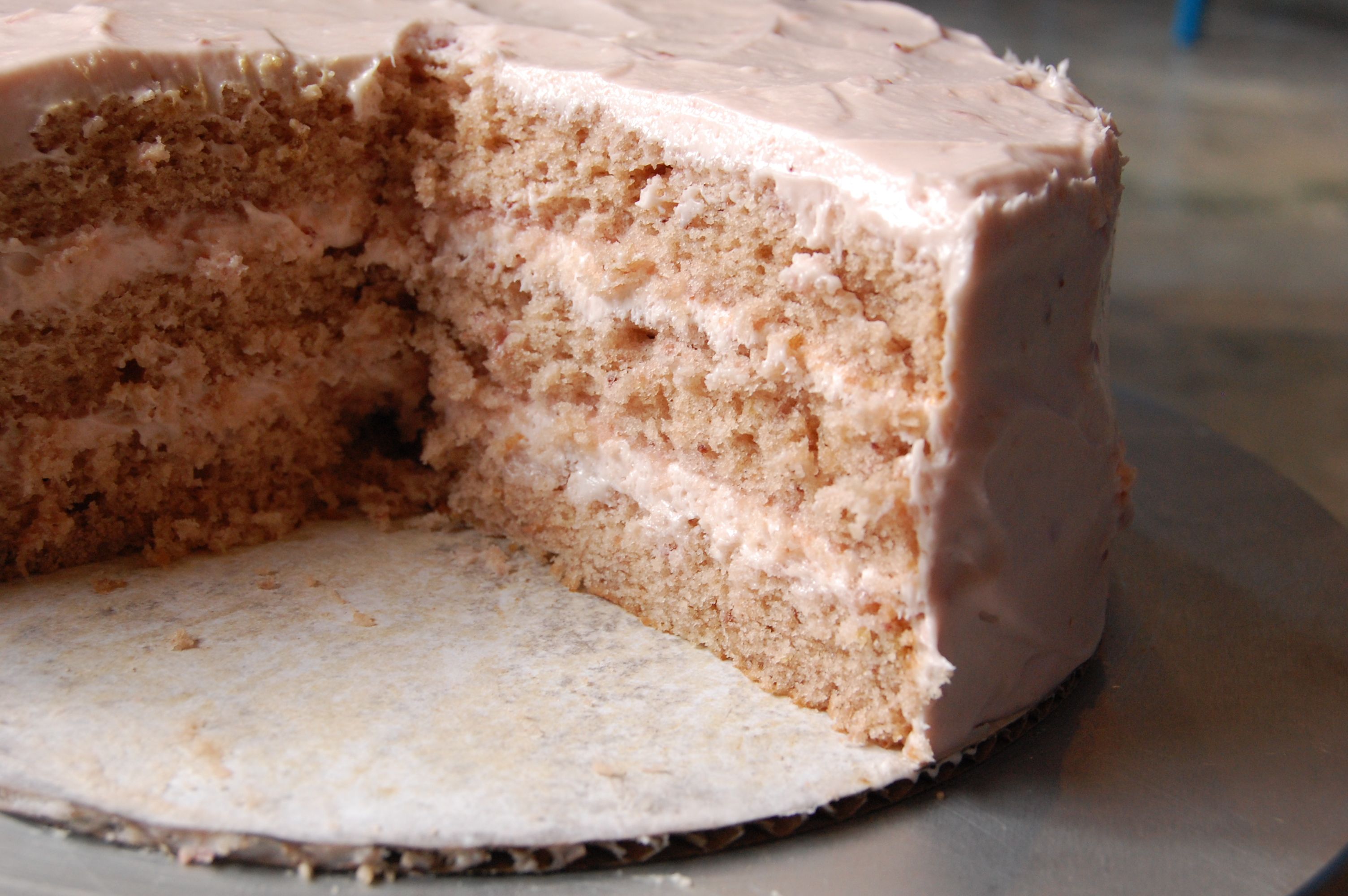
SOUTHERN STRAWBERRY CAKE:
Yield: 1 three layer 8″ cake
10 ounces (2 1/2 cups) cake flour
1 tsp baking soda
1/2 teaspoon kosher salt
1/3 cup buttermilk
1/4 cup canola oil
1/2 teaspoon almond extract
1/2 vanilla bean
4 ounces unsalted butter, room temperature
1 1/2 cups sugar
2 large eggs, room temperature, beaten
1 cup pureed strawberries
1 teaspoon lemon zest
– Preheat the oven to 350 degrees. Butter three 8” cake pans and line with rounds of parchment. Set aside.
– In a medium bowl, sift together the flour, baking soda, and salt. Set aside.
– In another medium bowl, combine the buttermilk, oil, and almond extract. Set aside.
– Split and scrape out the seeds from the vanilla bean. Rub the seeds into the sugar. In an electric mixer, beat the butter and vanilla sugar with the paddle attachment until it forms a paste. Add the eggs in a slow stream, beating well after each addition. Beat for 1 minute at medium speed. Gradually add the buttermilk mixture and beat for 1 minute at medium speed.
– Reduce the speed to low and add the flour mixture. Mix until just combined. Stir in the pureed strawberries and the lemon zest.
– Spoon into the prepared cake pans and bake until the cakes spring back when touched lightly in the center. Cool before removing from the pan.
STRAWBERRY CREAM CHEESE FROSTING:
1 pound cream cheese, room temperature
6 ounces unsalted butter
1 cup powdered sugar
6 tablespoons strawberry jam
1 teaspoon vanilla extract
2 teaspoons∑ lemon juice
1/4 teaspoon kosher salt
– In the bowl of a stand mixer with the paddle attachment, beat the butter and cream cheese on medium speed until smooth.
– Sift in the powdered sugar, and beat on low speed until incorporated. Add the strawberry jam, vanilla, lemon juice and salt, and beat well to incorporate. If the frosting is lumpy from the sugar, bump the speed up to medium-high continue beating until smooth.
Homemade Hot Sauce!
Sunday night we had our first Down South dinner at The Pantry. Boiled peanuts, homemade saltine crackers with pimento cheese and smoked ham, succotash, fried chicken, buttermilk biscuits. I have to admit, it was kind of amazing. Maybe I’m biased to Southern food in general, but there was something beautiful about watching complete strangers sit around the table and get in there with their fingers. The thing that threw it over the edge for me?
Homemade hot sauce.
You know the stuff. It’s pretty. It’s hot. It’s usually that awesome shade of orange that I can never find a paint chip to perfectly match. It makes me drool a little just to think about it. I’ve been buying this one brand, Youk’s, for years. The problem is that they only sell it online or in San Francisco, at this restaurant called Maverick. Needless to say, carting it back to Seattle after every trip got a little tedious. And once you’ve had the good stuff, it’s just hard to go back to Tabasco or Tapatío. If you’re as much a fan of the stuff as I am, then this is a very good day. I made it with my friend Brandon one day, a couple of weeks ago. It was kind of a shot in the dark, involving us poking around on the web for Southern-style recipes, then just winging it. It actually surprised me with how good it is. Who knew I had such little faith in myself? Anyhoo, get yourself to the farmer’s market before the peppers are gone, you’ll thank me.
We started by tossing some fresno chiles in olive oil and then roasting them in the wood-fired oven at Delancey for a bit. After they got nice and browned, we pureed them in a food processor with just enough vinegar to make them move around in there comfortably.

Then we placed the whole blob of pepper paste in a strainer and smashed it through. We took the liquid that came through and adjusted it with more vinegar, some water and lots of salt. And that’s it. So darn simple.

And crazy good. We made about 6 cups of it and have already gone through a quart. In two weeks. There’s been a lot of heartburn at The Pantry this month, but no one’s complaining.

Hot Sauce Recipe:
1 lb Fresno chiles
15 TBSP distilled vinegar
1 TBSP water
1 3/4 tsp kosher salt
– Trim the stems off of the chiles, leaving the base that the stem attaches to. Rumor has it that that part gives great flavor. Who am I to challenge a good culinary rumor?
– Toss the chiles in enough olive oil to coat them. Then roast them in a broiler, or grill them if you can. The goal is to get a nice char on them.
– Puree them in a food processor or blender with enough vinegar to keep them moving.
– Strain them through a fine sieve, smashing the whole time to get as much of the pulp as possible.
– Add the water, salt and the rest of the vinegar and pop in the fridge to chill for a few days. You can certainly eat it immediately, but it only gets better with time.
Finally, a Gratin
I’ve been searching for this recipe for quite a while now. A gratin. A great dish. A great word. Grataaaaaaaannnn… I could repeat it many, many times without getting bored. Maybe I should get a more interesting life?
But anyways, the point is that gratin should be easy enough. When I imagine it, it’s just like in Ratatouille, where I effortlessly slice some veggies and toss them into a shallow dish with a little cheese and herbs. A quick trip in the oven later and out comes a beautiful summer dinner. Somehow though, mine never go that way. They’re always too “something”: too watery, too heavy, too oily, too bland. I had all but given up on the gratin until I happened upon this recipe. The photo made me so hungry that I actually placed a zucchini gratin on the menu for a class I’m teaching at The Pantry because THEN I would HAVE to recipe-test it to perfection. Oh my friends, summer just got better. For me anyways. What better way to use up the mountain of summer squash growing in your garden than with trays and trays of crispy, cheese-laden, buttery breadcrumbed gratin?
Sure, this wasn’t as easy-peasy as the gratin in my fantasies, but it certainly was as tasty. I started by salting some thinly sliced zucchini until it released all of its water.

Then I got to work on the magic herby sauce that I would eventually toss the zucchini in.

And browned butter, did I mention that there was browned butter involved? It gets tossed into fresh breadcrumbs to make a nutty slice of heaven.

Everything got tossed together with some gruyere.

And baked until it was nicely browned and crispy.

And then yes, me and my good friend Merriss ate it straight out of the pan. There were some burned mouths by the end, but we didn’t really care. We were in a gratin coma.

I made a few changes to the original recipe: more cheese, slightly less oil and shallots, and a lot more lemon juice. I left out the jalapeno, which I know is a bit weird for me, but I really wanted the zucchini to have center stage on this one.
Zucchini Gratin with Salsa Verde
Yield: 4 servings
Salsa Verde:
1 teaspoon fresh oregano
1/4 cup coarsely chopped mint
1 cup coarsely chopped parsley
1 small clove garlic
1 anchovy
1/2 cup olive oil
1 tablespoon capers, drained
1 tablespoon lemon juice
1/2 teaspoon kosher salt
Black pepper to taste
Gratin:
2 pounds zucchini
1 1/2 cup fresh breadcrumbs
3 tablespoons unsalted butter
1/2 cup sliced shallot
1 teaspoon minced garlic
1 tablespoon fresh thyme
1 1/2 cups grated Gruyere cheese
– Heat the oven to 400 degrees. Cut the squash into 1/8-inch-thick slices. Toss the slices in a large bowl with 1 teaspoon kosher salt, and let sit for 30 minutes.
– Meanwhile, using a food processor, grind the herbs, garlic and anchovies and half of the oil to a paste. Transfer the mixture to a bowl.
– Gently pound the capers until they’re partially crushed and add them to the herbs. Stir in the remaining oil, the lemon juice, salt and black pepper. Taste for balance and seasoning.
– Place the breadcrumbs in a bowl. Heat the butter in a small saute pan over medium heat for a few minutes, until it browns and smells nutty. Pour the brown butter over the breadcrumbs, being sure to scrape all the brown bits into the bowl with a rubber spatula. Wait a minute or so for the butter to cool, and toss well. Set aside.
– Drain the squash well and transfer it to a large mixing bowl. Add the shallots, minced garlic, thyme, 1/2 cup of the salsa verde, and some pepper. Toss to combine, and add the cheese and half the butter-coated breadcrumbs. Toss again, and taste for seasoning.
– Place the squash in a 9-by-9-inch gratin dish. Scatter the remaining breadcrumbs over the top, and bake 40 to 45 minutes, until the squash is tender and the top is crisp.
I Totally Made That.
Sooooo… you might have noticed that I’ve been pretty much MIA. As you may know, for the past year I’ve been working on starting my own business, The Pantry. I’ve certainly complained enough about the long hours and lack of time, but did I tell you that I built it with my tiny little hands? I had lots of help for sure, from my two business partners, Olaiya Land and Brandon Pettit, and countless friends. But this project, the realization of a dream I’ve had for a long time, now THAT was intense. And awesome. And exhausting. And completely impossible at times. But what can a girl do? A dream awaited, and I certainly don’t have the funds to pay OTHER people to build it. Since I worked as an architect before making the big switch to pastry, designing a beautiful kitchen wasn’t a stretch, but after nine months of being permanently attached to my Carhart overalls, I learned really fast how to not just make spaces that are pretty on paper, but how to actually make them stand up. Needless to say, I’ve been left with zero energy for making things in the kitchen, hence the lack of posting. So I wanted to share with you what I HAVE been making, even if it’s not edible.
When we started, it was a certified dump. Carpet peeled away to reveal layers and layers of linoleum, then a good thick layer of glue.

There was this low popcorn ceiling, with track lighting. When I first looked at it, I wanted to run away right then. THIS was going to be a BIG task. But when we peeled away the ceiling, there were these beautiful old wood joists peeking out. I like to think of those joists as the beginning of the design for The Pantry.

We had a rule of trying to find as many of our materials as possible used, from architectural salvage stores. On one of our early visits, in the dark days of winter, we came across a door. It looked like it would fall into pieces if you looked at it wrong. And according to our friend and carpenter Joe, who fixed it, it did. But it was $10 and we just had to have it. Between that door and the beautiful ceiling we were exposing, the space just started designing itself. It was to be a commercial kitchen, so there were… rules, but I really wanted it to feel like home. A place where people could feel comfortable just stopping by to say hello. Where after a class or dinner, people would want to linger. A place where a community is built.

And the table, man was that fun. The first thing we did, in the fall, was contact a carpenter in Portland about making us a 16-foot-long table. Everything would be centered around the table. It had to be wide enough to allow for classes, lots of hands flying at once. But it had to be narrow enough that you could meet the person sitting across from you. We love our table, and even after our original carpenter turned out to be crazy, and canceled the contract 3 weeks(!) before we were scheduled to host our first dinner, after our friend Joe (who fixed the door, and well, taught us how to do EVERYTHING) built it to my design in 8 days (costing many thousands more than we budgeted), we still fawn over this table.

We had our first dinner Friday night, and I dare say it was a complete success. 20 people, most not knowing each other, sat down for five courses, and made new friends. It was beautiful. That table is magic. And I look forward to maybe one day seeing some of you there.

A big whopping thank you to all of those who helped. Thank you for showing up on beautiful days when I knew you’d rather be on a long bike ride somewhere. On not-so-beautiful days, when building a deck in the mud was, like, the WORST idea ever. And for putting up with me when I had absolutely no idea what I was doing. Thank you Scott Elder for driving up from San Francisco in March, sleeping on our blow-up mattress and being my right arm for 3 months. Thank you to Joe Burmeister for, well, indulging my insanely tiny budget and teaching me and my friends so much. Thank you to Chris Saleeba and Bryan LaComa, for designing and teaching us how to create a garden space that gives me goosebumps. Thank you to Gabe Rodriguez, for taking gorgeous photos of the space under construction (the top two are his). Thank you to John, for not leaving me when I know I was behaving intolerably. Thank you to everyone who just walked by and told me how great everything was looking, you have no idea how much that helped on those rough days.
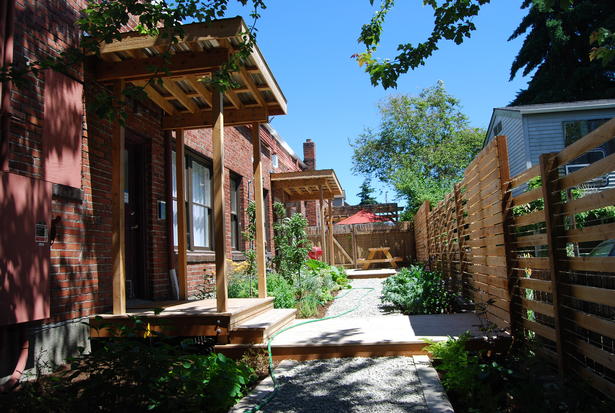


 I made that!
23 comments